domingo, 4 de mayo de 2014

Científicos confirman la existencia del elemento 117

Un nuevo elemento químico superpesado, el Ununseptio, ya es oficial

Tuvieron que pasar cuatro años de intensa investigación y más de algún dolor de cabeza, para poder confirmar ununseptio (Uup), un elemento que se integra a la tabla periódica.

Descubierto en 2010 por un grupo de físicos rusos y estadounidenses, en conjunto con el Instituto de Investigación Nuclear (Jinr, por sus siglas en inglés), costó bastante en ser revisado y comprobado por sus pares, pero finalmente se logró.

Esta ratificación se realizó por el equipo del Centro GSI Helmholtz , y apareció en la revista científica Physical Review Letters .

Al igual que el equipo de Jinr, este grupo pudo crear este elemento al encender isótopos de calcio en berkelio radioactivo.

Algo que no fue simple, según relatan los investigadores.

Con esta confirmación, la Unión Internacional de Química Pura y Aplicada agregó el elemento en las tablas periódicas, específicamente a los elementos transuránicos.

"Hacer este elemento está en el límite absoluto de lo que es posible en este momento", afirmó el profesor David Hinde, profesor de la Universidad Nacional de Australia.

Como otros transuránicos, ununseptio es inestable y su vida no dura más de 80 milisegundos.

Sin embargo, este tiempo es mucho más largo de lo que se esperaba del elemento, dejando la puerta abierta para que se pueda estabilizar.

Según los autores, este es "un paso importante para la observación de los núcleos de elementos superpesados ubicados en una 'isla de estabilidad' aún más longevas".

Con Información de la tercera
entornointeligente.com


Un nuevo elemento químico superpesado, el Ununseptio, ya es oficial

CarlosZahumenszky


Saludad al Ununseptio o Uus, conocido por los científicos como Elemento 117.

Un grupo internacional de físicos liderado por el centro de investigación GSI de Alemania, acaba de lograr sintetizar cuatro átomos de este elemento químico.

Es un 40% más pesado que el plomo, y el segundo elemento más pesado del mundo.

El Ununseptio o Elemento 117 no es nuevo.

Los primeros en sintetizarlo fueron un grupo de investigadores rusos y americanos de la Universidad de Dubna, en 2010, pero no estaba reconocido.

Para que un nuevo elemento químico sea admitido en la tabla periódica, debe de ser sintetizado al menos por dos laboratorios independientes.

Esa doble confirmación es la única manera de que la Unión Internacional de Química Pura y Aplicada (IUPAC) apruebe su entrada en la tabla.

La confirmación de la nueva síntesis del Elemento 117 ha sido anunciada hoy por la Universidad Nacional de Australia, que también participaba en el proyecto.

Falta, no obstante, el veredicto oficial de la IUPAC para que entre definitivamente en la tabla periódica.

El juego de los elementos imposibles


El peso de un elemento químico se mide mediante su número atómico, que indica la cifra total de protones que tiene cada átomo de ese elemento.

El Californio tiene 98 protones.

A partir de ahí, todos los elementos más pesados han sido creados en laboratorios, generalmente bombardeando átomos de distintos materiales.

El Ununseptio (número atómico 117) era el elemento químico con más protones que quedaba por confirmar, pero no es el más pesado de la tabla periódica.

Ese récord lo tiene el Elemento 118, Ununoctio o Uuo, con 118 protones.

 Esta sustancia es radiactiva y muy inestable.

Tan solo se han producido un puñado de átomos de la misma en laboratorio.

Confirmados ya el 117 y el 118, suponemos que ahora la comunidad científica emprenderá una nueva carrera para encontrar los siguientes, el 119 y el 120. [Universidad Nacional de Australia vía Gizmag]

Foto: isak55 / Shutterstock
gizmodo.com

martes, 8 de octubre de 2013

Is teleportation possible? It has been achieved with an atom

teletransporte-640x200

Por Pablo G. Bejerano

A team of physicists from the University of Queensland (Australia) was able to move an atom using a technique based on quantum mechanics, which could be described as teleportation.

There is a long list of science fiction myths that have become reality over the years.

Teleportation is one of those dreams that have occupied the minds of creators and fans in film and literature.

Dreaming is one thing, but the scientific experiments that are being conducted today are something radically different.

Nevertheless, there is no other name for what Australian researchers have done with an atom.

The work was carried out at the University of Queensland in the Australian city of Brisbane and their results have been reported in the journal Nature, which presents a detailed explanation of the experiment and its bases.

The technique has attracted so much attention that even the researchers have been unable to resist the comparisons.

“In this process the information simply appears at the destination, almost like the teleportation used in the popular science fiction series Star Trek”, says Dr. Arkady Fedorov, one of the team leaders.

But what actually happens?

The fact is that the researchers have managed to send an atom from one place to another within a chip without using a physical means of transport. Scientists call the information that has changed place ‘quantum information’.

According to Dr. Fedorov, the process is made possible by the laws of quantum mechanics.

To do this one must first obtain –-and this is the key issue of the research– a kind of link or correlation called entanglement in English, shared by the information’s origin and its destination.

According to quantum mechanics, this correlation is what makes possible a phenomenon hitherto considered impossible.

One of the aspects stressed by researchers is that quantum teleportation has been used in a circuit, just as today’s modern computers contain a circuit through which information travels.

They claim that this technique allows us to move data with a speed and accuracy far beyond what has been achieved before.

Real-world applications of quantum teleportation
The research results could be used in larger networks and electronic chips with higher performance.

In the future data transmission speeds will serve to improve devices.

Quantum teleportation could also be useful for secure communications and more efficient data processing.

Research into quantum systems can be applied in many different scientific disciplines, from physics and engineering to biology or medicine.

This work opens the door to a different kind of communication than we have known until now, and its usefulness extends to a multitude of areas in which the connection speed between two points is critical.

blogthinkbig.com


jueves, 29 de agosto de 2013

Confirman la existencia del ununpentio, el elemento 115 de la tabla periódica

Un modelo de la configuración electrónica del elemento ununpentio
Científicos de la universidad sueca de Lund presentan esta semana en The Physical Review Letters nuevas pruebas que confirman la existencia de un elemento químico desconocido: el que posee el número atómico 115.
El nuevo elemento pertenece al grupo de los superpesados y todavía no ha sido ‘bautizado’ oficialmente, aunque su nombre temporal es ununpentio (Uup).
El experimento que ha llevado a su análisis se ha desarrollado en el centro de investigación GSI (Alemania). 
“Ha sido un experimento muy exitoso y uno de los más importantes en este campo en los últimos años”, destaca Dirk Rudolph, profesor de la división de Física Atómica en la Universidad de Lund.
Los resultados confirman mediciones anteriores efectuadas por grupos de investigación en Rusia, en concreto en el Instituto Conjunto para la Investigación Nuclear en Dubna.
Ahora, los investigadores han bombardeado una fina capa de americio con iones de calcio, de forma que han podido medir los fotones en relación con la desintegración alfa del nuevo elemento. Ciertas energías de los fotones concuerdan con las energías esperadas para la radiación de rayos X, que se considera una ‘huella dactilar’ de cada elemento.
Además de las observaciones del ununpentio, los investigadores también han tenido acceso a datos que ofrecen una visión más detallada de la estructura y propiedades de los núcleos atómicos superpesados.
Un comité internacional revisará los nuevos hallazgos para decidir si se necesitan más experimentos antes de que el descubrimiento del nuevo elemento sea reconocido de forma oficial.
Fuente: Universidad de Lund via SINC

El elemento 115 fue sintetizado por primera vez en 2004 por científicos estadounidenses y rusos y sus propiedades posteriormente fueron confirmados en varios experimentos hasta que los científicos de la Universidad de Lund han ofrecido las confirmaciones finales necesarias para hacer al elemento 115 oficial. 
El tiempo de vida medio más largo para el elemento 115 hasta la fecha es de aproximadamente 200 milisegundos, así que no se recomendaría hacer algo de valor del nuevo elemento.


domingo, 10 de marzo de 2013

Chasing the Higgs Boson


Illustration by Sean McCabe/Photographs by Daniel Auf der Mauer, Toni Albir, Fabrice Coffrini, Fred Merz


Peter Higgs, center, of the University of Edinburgh, was one of the first to propose the particle’s existence. From left, physicists at CERN who helped lead the hunt for it: Sau Lan Wu, Joe Incandela, Guido Tonelli and Fabiola Gianotti.

At the Large Hadron Collider near Geneva, two armies of scientists struggled to close in on physics' most elusive particle.

Vivek Sharma missed his daughter.

A professor at the University of California, San Diego, Dr. Sharma had to spend months at a time away from home, coordinating a team of physicists at the Large Hadron Collider, here just outside Geneva. But on April 15, 2011, Meera Sharma’s 7th birthday, he flew to California for some much-needed family time. “We had a fine birthday, a beautiful day,” he recalled.

Then Dr. Sharma was alerted to a blog post. There it was reported that a rival team of physicists had beaten his team to the discovery of the Higgs boson — the long-sought “God particle.”

If his rivals were right, it would mean a cascade of Nobel Prizes flowing in the wrong direction and, even more vexingly, that Dr. Sharma and his colleagues had missed one of nature’s clues and thus one of its greatest prizes; that the dream of any physicist — to know something that nobody else has ever known — was happening to someone else.

He flew back to Geneva the next day. “My wife was stunned,” he recalled.

He would not see them again for months.

Dr. Sharma and his colleagues had every reason to believe that they were closing in on the Great White Whale of modern science: the Higgs boson, a particle whose existence would explain all the others then known and how they fit together into the jigsaw puzzle of reality.

For almost half a century, physicists had chased its quantum ghost through labyrinths of mathematics and logic, and through tons of electronics at powerful particle colliders, all to no avail.

Now it had come down to the Large Hadron Collider, where two armies of physicists, each 3,000 strong, struggled against each other and against nature, in a friendly but deadly serious competition.

In physics tradition, they were there to check and complement each other in a $10 billion experiment too valuable to trust to only one group, no matter how brilliant and highly motivated.

The stakes were more than just Nobel Prizes, bragging rights or just another quirkily named addition to the zoo of elementary particles that make up nature at its core. The Higgs boson would be the only visible manifestation of the Harry Potterish notion put forward back in 1964 (most notably by Peter Higgs of the University of Edinburgh) that there is a secret, invisible force field running the universe. (The other theorists were François Englert and Robert Brout, both of Université Libre de Bruxelles; and Tom Kibble of Imperial College, London, Carl R. Hagen of the University of Rochester and Gerald Guralnik of Brown University.)

Elementary particles — the electrons and other subatomic riffraff running around in our DNA and our iPhones — would get their masses from interacting with this field, the way politicians draw succor from cheers and handshakes at the rope line.

Without this mystery field, everything in the universe would be pretty much the same, a bland fizz of particles running around at the speed of light. With it, there could be atoms and stars, and us.

Leon Lederman, the former director of the Fermi National Accelerator Laboratory, or Fermilab, in Illinois, where the boson was being sought, once called it “the God particle,” scandalizing his colleagues but delighting journalists, who kept using the name. Dr. Lederman later said that he wanted to call it the “goddamn particle.”

The “Easter Bump Hunt” of April 2011, as it came to be called, was only one episode in a roller coaster of sleepless nights, bright promises, missed clues, false alarms, euphoria, depression, gritty calculation, cooperation and envy, all the tedium and vertiginous notions of modern science.

On the way to fulfill what they thought was their generation’s rendezvous with scientific destiny, the physicists dangled from harnesses in hard hats to construct detectors bigger than apartment buildings in underground caverns. They strung wires and cranked bolts to coax thousand-ton magnets to less than a thousandth of an inch of where they needed to be. They wrote millions of lines of code to calibrate and run devices that would make NASA engineers stand by the track with their hats in their hands in admiration.

In their down time, they proposed marriage and made rap videos in the tunnels where subatomic particles collided. They ate, slept and partied, threw snowballs and worried that an unguarded smile in the cafeteria or a glance at a friend’s laptop could bias a half-billion-dollar experiment or give away cosmic secrets.

Maria Spiropulu, a professor at the California Institute of Technology, put it this way in an e-mail, “The experiments are very large collaborations and they have the good, the bad, the crooks, the Sopranos, the opportunists — a prototype of the world as we know it.”

By DENNIS OVERBYE
nytimes.com
New York Times

sábado, 1 de septiembre de 2012

El arte de nombrar


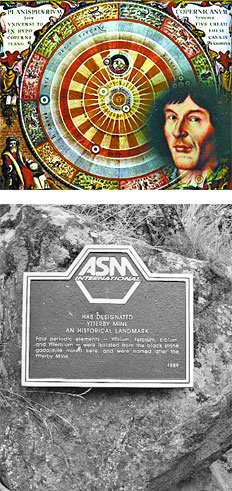
NICOLAS COPERNICO

PLACA CONMEMORATIVA DE YTTERBI, LUGAR QUE DA NOMBRE A CUATRO ELEMENTOS


En noviembre de 2011, la tabla periódica de los elementos le dio la bienvenida oficial a tres nuevos elementos químicos: el darmstadtio (Ds 110), el roentgenio (Rg 111) y el copernicio (Cn 112). 

La elección de estos nombres y símbolos es el resultado de muchas discusiones y negociaciones entre miembros e instituciones de la comunidad científica.

Por Claudio H. Sánchez
El nombre de un elemento químico perpetúa a un lugar (en el primer caso a Darmstadt, en Alemania) o a una persona ilustre (en los otros dos casos, a Roentgen y a Copérnico) y cada uno defiende a sus favoritos. 
En los años ’60, durante la Guerra Fría, se planteó este problema con algunos elementos descubiertos independientemente por laboratorios de Estados Unidos y de la Unión Soviética. 
En particular, el elemento número 104 fue obtenido en 1964 en el Instituto de Investigación Nuclear de Dubna, en Rusia. 
Lo llamaron dubnio y luego kurchatovio, en honor a Igor Kurchatov, considerado padre de la bomba atómica soviética.
En 1969 fue redescubierto por investigadores de la Universidad de Berkeley y propusieron el nombre rutherfordio, por el físico neocelandés Ernest Rutherford. 
La Iupac (Unión Internacional de Química Pura y Aplicada) adoptó temporalmente el nombre unnilquadium (uno-cero-cuatro), siguiendo un criterio sistemático para designar elementos a partir de su número atómico. 
Finalmente, en 1997, se aceptó oficialmente el nombre rutherfordio (Rf). 
El nombre dubnio se aplicó al elemento 105.

EN LA TIERRA COMO EN EL CIELO

Muchos elementos químicos han sido bautizados con el nombre de países, ciudades o distintas regiones de la Tierra. 
A veces, por la patria de su descubridor, como es el caso del polonio (Po), descubierto por María Sklodowska, madame Curie. 
Otras veces, por su lugar de procedencia, como el cobre (kyprus), abundante en la isla de Chipre. 
Y nuestro país es un ejemplo del caso contrario: ha sido bautizado con el nombre de un elemento, la plata.
Algunos países, ciudades y regiones tienen el privilegio de haber inspirado el nombre de más de un elemento. 
Por ejemplo, Francia tiene al francio (Fr) y al galio (Ga), aunque también se cree que este nombre es un autohomenaje que se hizo su descubridor, 
Paul Emile Lecoq de Boisbaudran: le coq, en francés, quiere decir “el gallo”. California tiene al californio (Cf) y al berkelio (Bk), por una de sus universidades más famosas.
En este sentido, el caso más notable es el de Ytterby, un pequeño pueblo minero ubicado en la isla sueca de Resaró, cerca de Estocolmo. 
En las minas de Ytterby se han descubierto cuatro elementos, bautizados en nombre del lugar: el ytrio (Y), el iterbio (Yb), el terbio (Tb) y el erbio (Er). 
Ningún otro lugar ha sido honrado tantas veces en la tabla periódica.
A la hora de elegir el nombre para un elemento químico, los investigadores no limitan su inspiración a la Tierra: hay elementos bautizados con el nombre de cuerpos celestes. 
El caso más notable es el del elemento número dos de la tabla, descubierto en 1868 por el astrónomo francés Pierre Jules César Janssen cuando observaba el espectro solar. 
Lo llamó con el nombre que los antiguos griegos le daban al Sol, Helio (He). 
Fue el primero (y, hasta ahora, único) elemento descubierto en el espacio exterior antes que en la Tierra.
En 1803 se descubrieron el cerio (Ce) y el paladio (Pd). 
Ambos recibieron sus nombres por dos asteroides, Ceres y Palas, observados por primera vez dos años antes.
El elemento 92, descubierto en 1789, fue llamado uranio (U) por el planeta Urano, descubierto en 1781. 
Cuando, ya en el siglo XX, la tecnología nuclear produjo los elementos 93 y 94, se volvió a mirar al sistema solar y se los bautizó neptunio (Np) y plutonio (Pu), respectivamente. Cuando le llegó el turno al elemento número 95, no había más planetas y se lo llamó americio (Am).

DE LOS SIMBOLOS

Normalmente, los símbolos de los elementos químicos son sus respectivas iniciales: C para el carbono, O para el oxígeno y así con muchos otros. 
A veces, se recurre al nombre del elemento en otro idioma, como la K para el potasio (del latín kalium) o la W para el tungsteno (del alemán wolfram). 
Y, como hay más elementos en la naturaleza que letras en el alfabeto, en muchos casos se debe recurrir a las dos primeras letras del nombre, como Ca para el calcio o He para el helio.
Pero hay un elemento cuyo símbolo es especialmente críptico: el mercurio, de símbolo químico Hg. Este símbolo deriva del nombre que los antiguos griegos le daban al mercurio: hydrargyros. 
La etimología de este nombre es muy sencilla. 
Hydros significa agua y, en general, líquido. 
Argyros, quiere decir plata. De modo que el hydragyros sería plata líquida. 
Parece natural que cuando los antiguos vieron mercurio por primera vez les pareció estar ante una extraña forma de plata líquida.
La idea del mercurio como plata líquida aparece también en otras palabras y expresiones. Alfonso X, el Sabio escribió un elogio de España en el que dice que esa tierra es “rica de metales de plomo, de estanno, de argén vivo, de fierro”. 
El “argén vivo” al que se refiere Alfonso X es el mercurio. España era el principal productor de mercurio durante la Edad Media.
La palabra inglesa quicksilver (plata rápida o movediza), que a nosotros nos recuerda una marca de ropa, es un antiguo nombre inglés para el mercurio. 
Es evidente que, para los antiguos ingleses, el mercurio era tan vivo como movedizo.
pagina12.com.ar

miércoles, 4 de julio de 2012

CERN experiments observe particle consistent with long-sought Higgs boson

boson_higgs_cern
At a seminar held at CERN1 today as a curtain raiser to the year’s major particle physics conference, ICHEP2012 in Melbourne, the ATLAS and CMS experiments presented their latest preliminary results in the search for the long sought Higgs particle. Both experiments observe a new particle in the mass region around 125-126 GeV.

“We observe in our data clear signs of a new particle, at the level of 5 sigma, in the mass region around 126 GeV. 

The outstanding performance of the LHC and ATLAS and the huge efforts of many people have brought us to this exciting stage,” said ATLAS experiment spokesperson Fabiola Gianotti, “but a little more time is needed to prepare these results for publication.”

"The results are preliminary but the 5 sigma signal at around 125 GeV we’re seeing is dramatic. This is indeed a new particle. 

We know it must be a boson and it’s the heaviest boson ever found,” said CMS experiment spokesperson Joe Incandela. 

“The implications are very significant and it is precisely for this reason that we must be extremely diligent in all of our studies and cross-checks."

“It’s hard not to get excited by these results,” said CERN Research Director Sergio Bertolucci. 

“ We stated last year that in 2012 we would either find a new Higgs-like particle or exclude the existence of the Standard Model Higgs. With all the necessary caution, it looks to me that we are at a branching point: the observation of this new particle indicates the path for the future towards a more detailed understanding of what we’re seeing in the data.”

The results presented today are labelled preliminary. 

They are based on data collected in 2011 and 2012, with the 2012 data still under analysis.  

Publication of the analyses shown today is expected around the end of July. A more complete picture of today’s observations will emerge later this year after the LHC provides the experiments with more data.

The next step will be to determine the precise nature of the particle and its significance for our understanding of the universe. 

Are its properties as expected for the long-sought Higgs boson, the final missing ingredient in the Standard Model of particle physics? 

Or is it something more exotic? The Standard Model describes the fundamental particles from which we, and every visible thing in the universe, are made, and the forces acting between them. 

All the matter that we can see, however, appears to be no more than about 4% of the total. 

A more exotic version of the Higgs particle could be a bridge to understanding the 96% of the universe that remains obscure.

“We have reached a milestone in our understanding of nature,” said CERN Director General Rolf Heuer. 

“The discovery of a particle consistent with the Higgs boson opens the way to more detailed studies, requiring larger statistics, which will pin down the new particle’s properties, and is likely to shed light on other mysteries of our universe.”

Positive identification of the new particle’s characteristics will take considerable time and data. 

But whatever form the Higgs particle takes, our knowledge of the fundamental structure of matter is about to take a major step forward.

ress.web.cern.ch

viernes, 29 de junio de 2012

Could the Large Hadron Collider Discover the Particle Underlying Both Mass and Cosmic Inflation?


LHC, large hadron collider, higgs boson
Within a sliver of a second after it was born, our universe expanded staggeringly in size, by a factor of at least 1026. 
That's what most cosmologists maintain, although it remains a mystery as to what might have begun and ended this wild expansion. 
Now scientists are increasingly wondering if themost powerful particle collider in history, theLarge Hadron Collider (LHC) in Europe, could shed light on this mysterious growth, called inflation, by catching a glimpse of the particle behind it. 
It could be that the main target of the collider's current experiments, the Higgs boson, which is thought to endow all matter with mass, could also be this inflationary agent.
During inflation, spacetime is thought to have swelled in volume at an accelerating rate, from about a quadrillionth the size of an atom to the size of a dime. 
This rapid expansion would help explain why the cosmos today is as extraordinarily uniform as it is, with only very tiny variations in the distribution of matter and energy. 
The expansion would also help explain why the universe on a large scale appears geometrically flat, meaning that the fabric of space is not curved in a way that bends the paths of light beams and objects traveling within it.
The particle or field behind inflation, referred to as the "inflaton," is thought to possess a very unusual property: it generates a repulsive gravitational field. To cause space to inflate as profoundly and temporarily as it did, the field's energy throughout space must have varied in strength over time, from very high to very low, with inflation ending once the energy sunk low enough, according to theoretical physicists.
Much remains unknown about inflation, and some prominent critics of the ideawonder if it happened at all. Scientists have looked at the cosmic microwave background radiation—the afterglow of the big bang—to rule out some inflationary scenarios. "But it cannot tell us much about the nature of the inflaton itself," says particle cosmologist Anupam Mazumdar at Lancaster University in England, such as its mass or the specific ways it might interact with other particles.
A number of research teams have suggested competing ideas about how the LHC might discover the inflaton. 
Skeptics think it highly unlikely that any earthly particle collider could shed light on inflation, because the uppermost energy densities one could imagine with inflation would be about 1050 times above the LHC's capabilities. 
However, because inflation varied with strength over time, scientists have argued the LHC may have at least enough energy to re-create inflation's final stages.
It could be that the principal particle ongoing collider runs aim to detect, the Higgs boson, could also underlie inflation.
"The idea of the Higgs driving inflation can only take place if the Higgs's mass lies within a particular interval, the kind which the LHC can see," says theoretical physicist Mikhail Shaposhnikov at the École Polytechnique Fédérale de Lausanne in Switzerland. Indeed, evidence of the Higgs boson was reported at the LHC in December at a mass of about 125 billion electron volts, roughly the mass of 125 hydrogen atoms.
Also intriguing: the Higgs as well as the inflaton are thought to have varied with strength over time. 
In fact, the inventor of inflation theory, cosmologist Alan Guth at the Massachusetts Institute of Technology, originally assumed inflation was driven by the Higgs field of a conjectured grand unified theory.
scientificamerican.com

lunes, 5 de diciembre de 2011

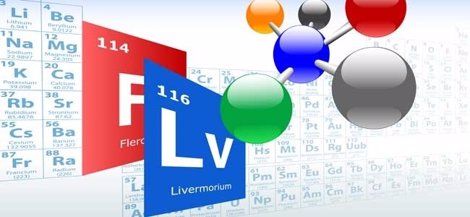
Flevorio y Livermorio, nuevos elementos de la tabla periódica


 OCUPAN LOS PUESTOS 114 Y 116

La Unión Internacional de Química Pura y Aplicada (IUPAC) ha recomendado este jueves los nuevos nombres propuestos para los elementos 114 y 116, los últimos elementos pesados que se añaden a la tabla periódica.

   Científicos del proyecto de colaboración Laboratorio Nacional Lawrence Livermore (LLNL)-Dubna propusieron los nombres como flerovio de 114 elementos y livermorio para el elemento 116.
  
 En junio de 2011, la IUPAC aceptó oficialmente los elementos 114 y 116 como los elementos más pesados, más de 10 años después de que científicos del Instituto Conjunto de Investigación Nuclear en Dubna y el Lawrence Livermore los descubriesen.

   El flerovio (con símbolo atómico Fl) fue escogido en honor del Laboratorio de Reacciones Nucleares Flerov, donde fueron sintetizados elementos superpesados como el 114. 

Georgiy N. Flerov (1913-1990) fue un físico de renombre que descubrió la fisión espontánea del uranio y fue un pionero en la física de iones pesados. 

Fue el fundador del Instituto Conjunto de Investigación Nuclear que en 1991 recibió su nombre.

   El livermorio (símbolo atómico Lv) fue elegido en honor al Lawrence Livermore National Laboratory (LLNL) y la ciudad de Livermore, California. 

Un grupo de investigadores del Laboratorio, junto con los científicos del Laboratorio de Reacciones Nucleares Flerov, participó en la labor llevada a cabo en Dubna en la síntesis de elementos superpesados, incluyendo el elemento 116.  

   La creación de los elementos 116 y 114 implica la transformación de los iones de calcio (con 20 protones cada uno) en un objetivo de curio (96 protones) para crear el elemento 116. 

El elemento 116 decayó casi inmediatamente en el elemento 114. 

Los científicos también crearon el elemento 114 por separado mediante la sustitución de curio con un objetivo de plutonio (94 protones).

  La creación de los elementos 114 y 116 generan la esperanza de que el equipo está en camino a la "isla de estabilidad", un área de la tabla periódica en la que nuevos elementos pesados serían estables el tiempo suficiente para determinar sus aplicaciones.

europapress.es

sábado, 11 de junio de 2011

Agregan dos nuevos elementos a la Tabla Periódica


La idea de que la Tabla Periódica cambie puede resultar extraña para algunos.

En general se piensa que es inmutable, permanente como las fórmulas matemáticas que vemos impresas en los libros.

Lo cierto es que debido a la naturaleza de algunos experimentos, cabe la posibilidad de que un nuevo elemento químico aparezca, aunque sea por unos segundos, incluso menos.

De hecho, durante los últimos 250 años se ha agregado un nuevo elemento cada 2.5 años, aproximadamente.

Tal es el caso del Ununquadium y el Ununhexium, ambos reportados hace ya varios años, que como parte de un estricto proceso de evaluación y a pesar de su breve existencia, quedarán inmortalizados en las posiciones 114 y 116, respectivamente.

Recordemos que la posición está determinada por el número de protones en el núcleo del átomo.

No con esos nombres, si no con otros al estilo Copernicio (Cn, 112) o Bohrio (Bh, 107), nombrados en honor de grandes científicos, lo cual sucederá en breve.

Los descubridores tienen derecho a elegir el nombre, por lo que es posible que sea Flerovio y Moscovio, en recuerdo de Georgy Flyorov y de la ciudad de Moscú.

Ununquadium fue descubierto en diciembre de 1998 producto de una colisión de isótopos de Plutonio y Calcio, llevada a cabo en el Instituto Central de Investigaciones Nucleares (ICIN), en Rusia, con el apoyo de científicos estadounidenses.

Treinta segundos fueron los que se mantuvo con “vida” antes de degradarse en otros elementos más estables. Durante 2009 se confirmó su existencia en otros laboratorios del planeta.

Ununhexium posee una historia muy similar. Su cuna también fue el ICIN, un año después que el Ununquadium.

En 2005 ocho átomos fueron reproducidos en otro laboratorio, y en 2009 tuvo lugar el experimento confirmatorio.

Otros elementos, 113, 115 y 118, siguen en proceso de evaluación, a la espera de evidencia más fuerte que confirme su existencia.

Alan Lazalde

alt1040.com

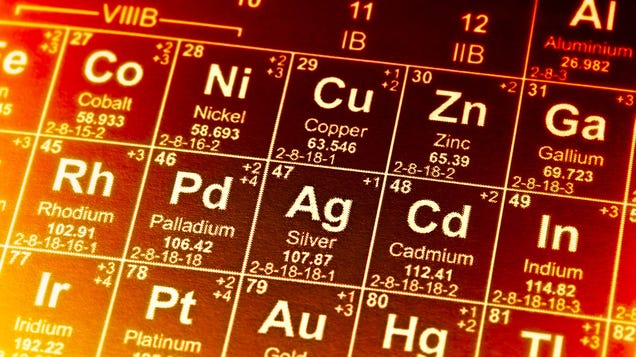
Periodic Table of Elements

sábado, 13 de junio de 2009